When the room lies
Every listening decision passes through the room. Standing waves, modes and reflections, why monitoring deceives, and what can be corrected (and what cannot).
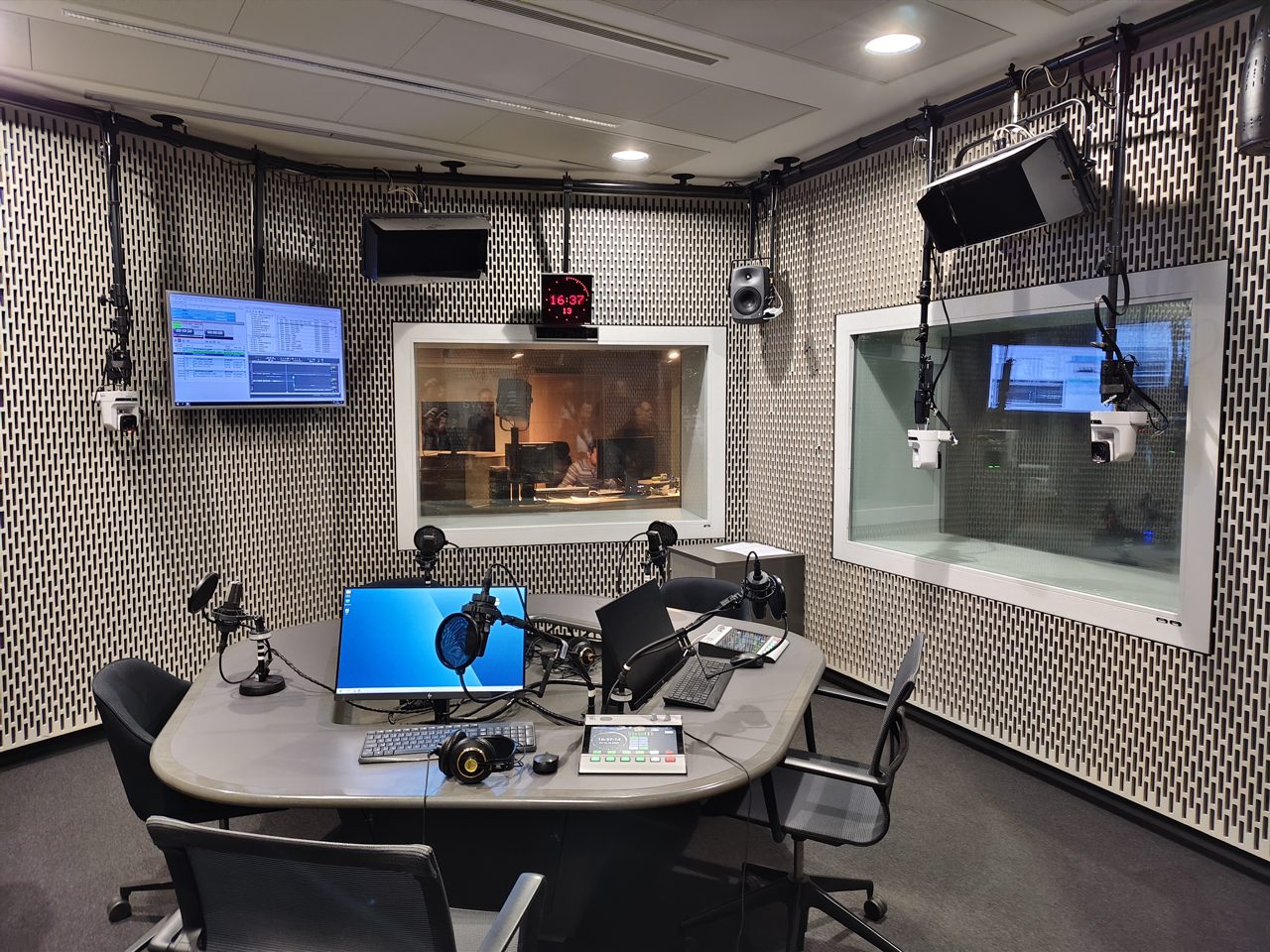
The hidden variable
Every decision passes through the room
You never hear your speakers. You hear your speakers plus the room, arriving together and inseparable by the time they reach your ears. Between the monitor and the listener sits a space full of surfaces, and that space adds its own signature to everything before you judge a single thing.
The danger is that you correct for it without knowing. If the room piles up energy at 100 hertz, your mixes sound bass-heavy in that chair, so you instinctively pull the low end down. The mix now measures thin everywhere else: in the car, on headphones, on a phone. You did not fix a problem. You encoded the room's lie into the master. Trustworthy monitoring is not about a flattering sound. It is about hearing what is actually there.
Standing waves
Why a room has notes
Sound bouncing between two parallel surfaces can fall into step with itself. At certain frequencies the reflections line up so that peaks land on peaks, and a standing wave forms, louder in some spots, cancelled in others. These are room modes, and a room rings at them the way a bottle rings when you blow across it.
Where those notes sit is set by the dimensions. The fundamental mode along one dimension is the speed of sound divided by twice that length, f = c / 2L, with c about 343 metres per second. A room 4.3 metres long resonates near 40 hertz, then again at its multiples, 80, 120, and on up. Every dimension, length, width and height, adds its own series, and the overlapping pattern is densest and most uneven in the bass. That is why the low end is the hardest part of any room to trust, and why two rooms with the same speakers can disagree completely below a couple of hundred hertz.
Two kinds of trouble
What you can fix, and what you cannot
Look at a room's frequency response and you see two kinds of fault: peaks where energy piles up, and nulls where it cancels. They look like mirror images on the graph, but they are not the same problem, and the difference decides what you are allowed to do about them.
A peak is a resonance, too much energy at one frequency, and you can take it down: a narrow EQ cut reduces it at the listening position, and bass trapping reduces it everywhere. A null is the opposite trap. It is two paths of sound arriving out of step and cancelling, and no amount of EQ can boost it back, because you would just be pouring energy into a frequency the room keeps erasing, burning headroom and adding distortion for nothing. A null is fixed by moving the speaker or the seat, not by turning a knob. The rule that follows is simple and counterintuitive: cut the peaks, never chase the nulls.
The other axis
The room rings in time, not just tone
A frequency response tells you what is too loud. It does not tell you how long the problem lasts, and in a real room that second question matters just as much. A mode does not just lift a frequency; it holds it, letting that note hang in the air after the sound that caused it has stopped. That lingering energy masks the detail underneath and turns the low end boomy and indistinct.
Decay is measured as the time for sound to fall by sixty decibels, and it is a different lens on the same room. You cannot shorten a decay with EQ, because EQ changes level, not time. Only physical absorption removes energy as it bounces, which is why treatment, not a filter, is what finally tightens a boomy room. Taming the peak helps, but the ringing is a problem you solve with material on the walls.
Room measurement and acoustic treatment methodology documented per space. Available on consultation.
What calibration can and cannot do
Measurement and corrective EQ are powerful, but they are a final polish, not a rescue. They come after placement and treatment have done the heavy lifting. They can pull down resonant peaks, smooth the mid and high range, and leave you a more even, more trustworthy curve, a gentle slope from low to high rather than a mathematically flat line, because a gentle slope is what a good room sounds like.
What they cannot do is fill a cancellation null, erase the flutter echo between two bare parallel walls, or undo a difficult shape. Those need geometry and material, not a graph. The honest goal is not a perfect room. It is a room that stops lying to you, so the decisions you make in it survive the trip to everywhere else.
Explore the divisions
